

The Robot Brain That Wouldn't Dance
Oh sure! Now it dances. But can it do the fandango?

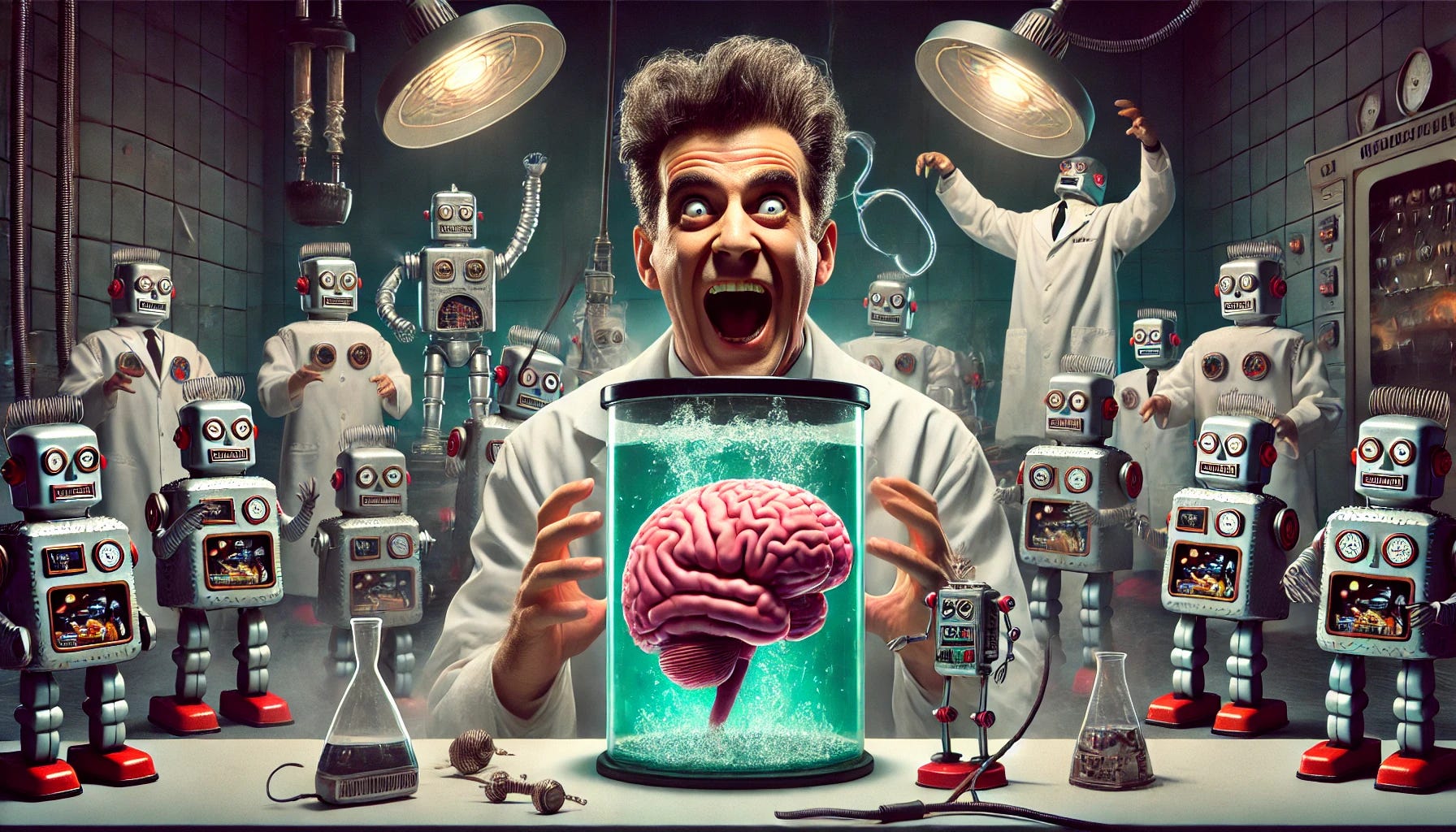
Back in the early 60s, there was an exceptionally cheesy horror movie (If you'll pardon the redundancy) called "The Brain That Wouldn't Die." It's been a long time since I saw it1 but I recall that it was about just-another-mad-scientist doing mad scientist things, as lots of horror movies of the time were. It comes up in the rotation of streaming choices every once in a while. I have so far not seen a reason to punish myself by watching it.
You might be wondering why I would bring up some awful old SF/horror movie if I haven't even watched it lately. It's because it was the first thing I thought of when I saw this headline: Step aside, Futurama: Scientists build robot that's controlled by a brain in a jar.
The headline turns out to be less than 100% accurate. Too bad. It's a great headline, except for the part about Futurama. I watched one episode of that (animated) show and lost interest.
So you probably want to know a more accurate version of the story, right? Okay. Current AI systems (Large Language Models or LLMs) make use of neural networks. NNs were inspired by the way real neurons in real brains work. We know that real neurons respond to electrical signals but only if the incoming signal is above a certain strength (called the threshold). That's fairly easy to simulate using software. You just code it to check every signal against a pre-determined value and respond if it's above. This is the kind of thing programmers code every day. We can do it in our sleep. Don't tell the boss that, okay?
Anyway, that's the inspiration for neural networks. The way they actually work is more complicated. So is the way the brain works. Really, the brain inspired artificial networks about the way the Salem Witch Trials inspired the old show Bewitched. In other words, don't think about it too much.
This research with the "brain in a jar" was an entirely different approach. Instead of, "Let's make a program that acts like a brain" somebody said, "Let's take a little piece of brain and use it for the brain!" Growing brain cells (and blood vessels!) from stem cells in order to do experiments with them, has been going on for a few years now. They add a computer chip in order to be able to get data into, and out of, the brain cells. It's called brain-on-chip2.
There's nothing like a whole brain here. Just a tiny fraction of one. But it's still able to learn a few basic things. Plus, it learns them a lot faster than non-biological AIs. Those need at least thousands of pieces of data to learn a very narrow thing and an LLM like ChatGPT needs trillions. By contrast, show a 2-year-old a cat once, and watch them point to everything with legs and shout, "Kitty!"
So in the article I linked to, it describes how they used one of these brain-on-chip systems to make some simple decisions for a robot. It learns faster than a neural network, costs less to maintain and uses less power. This is amazing stuff.
Like me, you're probably wondering what happens if they use a bigger brain? Will it get smarter? Will it get harder to control? Will the cells continue differentiating until you have a complete, fully functional, disembodied human brain3? Then you have to deal with all those little human problems like loneliness, depression and an overpowering desire for revenge. Not that you could tell if that stuff is there just from a little chip attached to it.
Oh! I just thought of another problem. The way you look into human brains is using functional Magnetic Resonance Imaging (fMRI). It lets you see where the blood is going, showing how active different parts of the brain are. But you can't do that with a brain-fragment that has a chip in it. Chips and magnets go together about as well as fire and gasoline.
Poof! No more brain-on-chip.
I wonder how they're going to get around that?
Note: This column is a bit shorter than most previous ones. That's because I'm starting a new job and it's cutting into my writing time. I'll try to keep the same Tuesday-Friday schedule but with a reduced word count. I don’t think the quality is that much reduced, so far. What do you think?
Here's that prompt: "A bionic brain in a jar with a 1950s movie style mad scientist watching and laughing. The background is filled with robots line dancing, with clear dancing poses such as kicking legs and waving arms. The scene is set in a classic mad scientist's laboratory with bubbling beakers, electrical equipment, and an eerie glow. The mad scientist has the exaggerated, dramatic look typical of 1950s movies, with wild hair, lab coat, and expressive face."
Don't forget to check out Technoscreed's less silly cousin, History Road!
I did not see "The Brain That Wouldn't Die" at a theater, in case you were wondering. I was too young to drive myself to the theater.
My brain on choclate chip cookies apparently doesn’t count.
By the way, one experiment with this kind of tech started by editing the DNA from the original stem cells to be more like Neanderthal DNA. I don't know if they're going to learn anything meaningful from this kind of thing. I just think it would be incredible to be paid to do stuff like that!